What Is the Church? The Mission of the Church — The Church for the World
Introduction
Have you ever sat in a church service and felt — somewhere beneath the worship and the sermon and the announcements — that something was missing?
Not missing from the theology. Not missing from the structure. But missing from the direction. As if the whole thing was pointed inward, feeding itself, serving its own members, keeping its own people comfortable — while the world outside continued to move further from God.
That feeling has a name. It is the instinct that something is wrong when the Church turns in on itself.
The Church was never meant to be a members-only club. It was never designed to exist for the sake of its own survival, its own programs, or its own comfort. From the very beginning, the Church was built to go somewhere.
In the previous articles in this series, we looked at the Church from the inside — its identity, its fellowship, its worship, its ordinances. We saw that the Church is a deeply rooted, living community. Not a weekly gathering. A body.
But a body exists to move. And the direction God always intended the Church to move was outward — toward the world He loves.
This article is about that movement. Why the Church cannot live for itself. And what it looks like when it does.
The Mistake: A Church Turned Inward
Let us be honest about something first.
The temptation to turn inward is real — and it is not always obvious. It does not usually look like selfishness. It looks like focus. It looks like depth. It looks like taking care of your own people well before you try to reach anyone else.
And there is a theological argument that has been made — sometimes thoughtfully — for separating the internal work of the local church from the external work of mission. Some theologians and missiologists have suggested that the local church is primarily responsible for worship, pastoral care, and internal discipleship, while the work of reaching the nations belongs to mission agencies and parachurch organizations.
Yong Ree expressed this view directly, arguing that “the function of the New Testament church is directly related to pastoral care and church order… the mission structure is a structure primarily related to mission orientation while the local church is a center for worship and pastoral care.”¹
And on the surface, that might sound reasonable. Pragmatic. Even organised.
But it is not what the New Testament teaches.
Camp identified the real problem with this kind of thinking — it reduces the Church to a function, and in doing so, misses what the Church actually is. The question is not simply “what does each entity do?” but “what is the Church in its very nature?” And when you answer that question honestly from Scripture, the separation falls apart.
The local church is not a pastoral care center with a mission agency attached on the side. It is a sent community. Being sent is not an add-on to its identity. It is part of what it means to be the Church at all.
”As the Father Sent Me”
Before we look at what the early churches did, we need to look at what Jesus said.
On the evening of His resurrection, Jesus appeared to His disciples and said something that reframes everything:
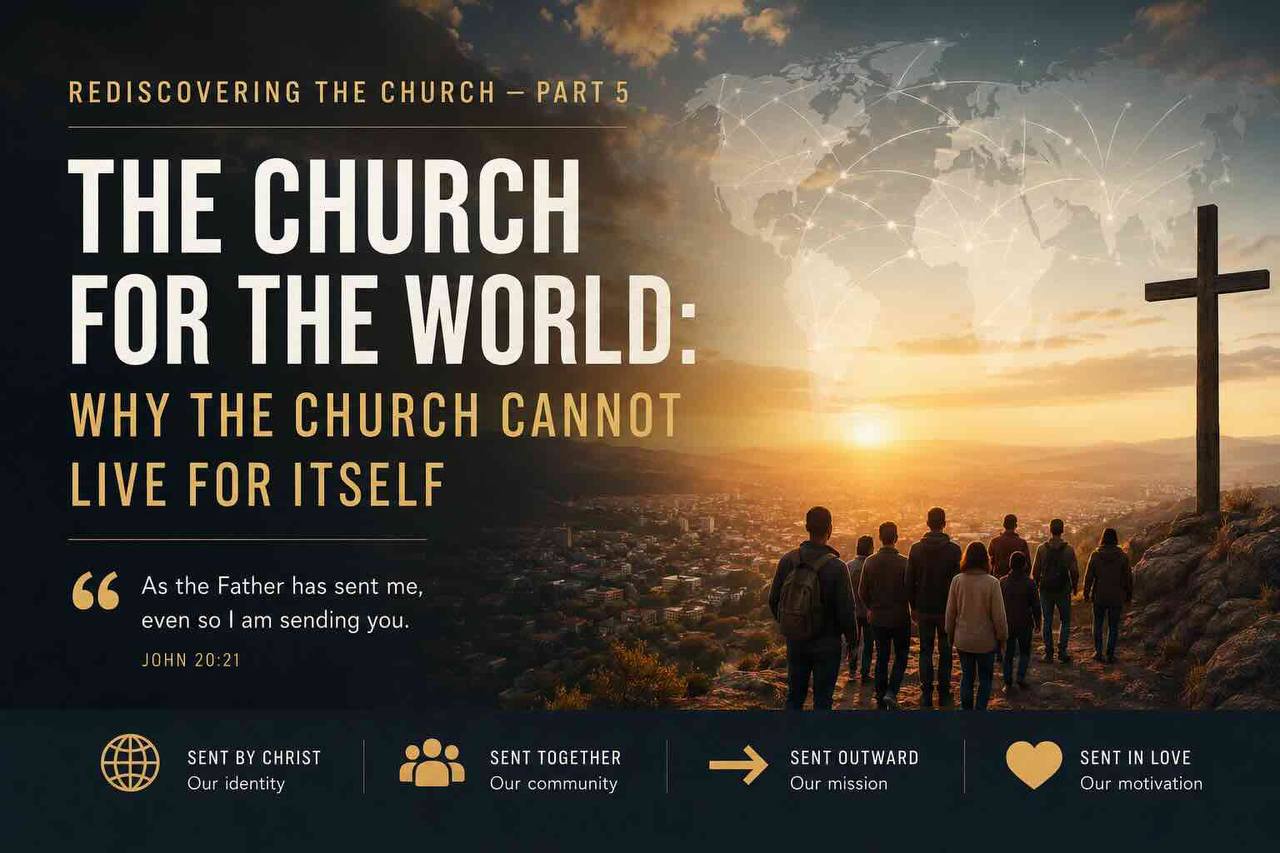
“As the Father has sent me, even so I am sending you.” (John 20:21)
Notice the structure of that sentence. The sending of the Church is modelled on the sending of the Son. The same way the Father sent Jesus into the world — not to be served, but to serve; not to stay in heaven, but to enter the world — Jesus sends His Church.
This means the Church’s mission is not a programme it adopts. It is a pattern it inherits. The Church is sent the same way Jesus was sent — into the world, for the world, on behalf of the One who loves the world.
And then in Matthew 28:18-20 — the Great Commission — Jesus grounds the sending in His own authority:
“All authority in heaven and on earth has been given to me. Go therefore and make disciples of all nations, baptising them in the name of the Father and of the Son and of the Holy Spirit, teaching them to observe all that I have commanded you. And behold, I am with you always, to the end of the age.”
The commission is not given to a mission agency. It is given to disciples. It is given to the Church. And it is grounded not in strategy or resources — but in the total authority of the risen Jesus and His permanent presence.
The Church does not go because it has a good plan. It goes because He told it to — and He goes with it.
The New Testament Churches: A Pattern of Going Out
The theology is clear. But the New Testament does not just give us doctrine — it gives us examples. And the examples are consistent.
Jerusalem sends outward
In Acts 11:19-24, we see the Jerusalem church responding to what God was doing among the Gentiles. When believers scattered by the persecution of Stephen began preaching to Greeks in Antioch and a great number turned to the Lord — Jerusalem did not wait for an agency to take responsibility. It sent Barnabas. The local church moved toward what God was doing, and it sent one of its own sons to join it.
The church did not outsource mission. It participated in it.
Antioch models the sent church
Acts 13:1-3 is one of the most important passages in the entire New Testament for understanding the missionary nature of the local church.
“While they were worshipping the Lord and fasting, the Holy Spirit said, ‘Set apart for me Barnabas and Saul for the work to which I have called them.’ Then after fasting and praying they laid their hands on them and sent them off.”
Notice where the call to mission came from — in the middle of worship. Not from a committee. Not from a strategy meeting. From a community gathered before God in prayer and fasting, listening to the Holy Spirit.
And notice what the church did — it sent its own people. Its best people. Barnabas and Saul were not peripheral members. They were central to the life of that community. And the church let them go.
A church that is truly sent will eventually send others.
Philippi partners in the mission
In Philippians 1:5, Paul commends the church at Philippi for their partnership in the gospel. But the letter shows us that this partnership was not abstract encouragement from a distance. The Philippian church entered the mission personally, sacrificially, and relationally.
They prayed — not as a passive gesture but as active participation in what God was doing on the other side of the world. They suffered alongside Paul — sharing in the cost of the gospel rather than observing it safely from their own comfort. They sent Epaphroditus — one of their own members, not a hired representative — to serve Paul in person. And they gave financially, becoming the one church Paul openly acknowledged as a consistent partner in his work.
These four movements together paint a picture of a church that understood itself to be in the mission, not simply supporting it from the outside. They did not delegate the gospel to Paul and consider their responsibility fulfilled. They went with him — in prayer, in sacrifice, in person, and in resource.
That is what missional partnership looks like for a local church. Not a line in the budget. A way of life.
Thessalonica becomes a sending centre
Paul’s words to the Thessalonian church are remarkable: “For not only has the word of the Lord sounded forth from you in Macedonia and Achaia, but your faith in God has gone forth everywhere.” (1 Thessalonians 1:8)
A young local church — not a mission agency, not an organisation — became a centre from which the gospel radiated in every direction. John Stott summarises it well:
*“God’s purpose is for every local church to be a sending church — first to receive the gospel and then to pass it on to others. This is God’s simple plan for evangelising the world. If every local church had accepted this responsibility, the world would have been evangelised long ago.”*²
That is not an exaggeration. It is a diagnosis.
And it asks every local church a searching question: are we receiving the gospel and keeping it, or receiving it and sending it?
The Theological Foundation: Missio Dei
The missional nature of the Church is not a modern programme — it is rooted in the character of God Himself.
Theologians like David Bosch and Jürgen Moltmann have given this a name: Missio Dei — the Mission of God.³ The idea is that mission is not primarily the activity of the Church. It is the nature of God. God is a sending God. The Father sent the Son. The Father and Son sent the Spirit. And the Holy Trinity sends the Church into the world.
Bosch writes: *“Mission is not primarily an activity of the church, but an attribute of God. God is a missionary God.”*⁴
This changes everything.
If mission belongs to God — then the Church does not own it. The local church does not own it. The mission agency does not own it. Both are invited to participate in something larger than either of them.
And when either one forgets that — the problems begin.
A church that forgets it is sent becomes a members club. It exists for the comfort and convenience of its own people. It measures success by attendance, budget, and programmes — not by whether the world around it is being reached. The energy flows inward. The vision shrinks.
A mission agency that forgets it is participating in God’s mission — not conducting its own — becomes an institution that serves its own agenda. It builds its own brand, protects its own territory, and loses the humility that belongs to every servant of the Lord.
One participant in my research put it simply: “Partnership must be built on building God’s kingdom, not my own agenda — otherwise I am building my own kingdom.”
That is a sentence worth sitting with.
What the Theologians Say
Three theologians have shaped my thinking on this — and I want to name them clearly.
D.A. Carson — the Gospel as the Centre
Carson argues that the mission of the Church must be rooted in the full biblical narrative. The Church is not primarily called to social justice or cultural transformation — though both matter. It is called to proclaim the gospel and make disciples of all nations, because that is the means God has appointed for His redemptive purposes.
Carson writes: *“The church has been commissioned to proclaim the gospel, to make disciples of the nations, and to serve the world in the name of Jesus, because that is the means God has appointed to accomplish his redemptive purposes.”*⁵
I want to add my own perspective here: social justice, compassion, and meeting real human needs are not optional — they are important and necessary. But in my understanding, they are the natural fruit of proclaiming the gospel and the work of reconciliation, not a substitute for it. When a person is reconciled to God, they are reconciled to themselves, to others, and to the world — and their whole life becomes worship.
John Piper — Mission Exists Because Worship Does Not
Piper’s most famous sentence on mission is this: “Missions exists because worship doesn’t.”
For Piper, the ultimate goal of the Church’s mission is not simply social change or human flourishing — it is drawing people into worshipping relationship with God. The Great Commission is about filling the earth with worshippers. And the Church that understands this will not treat mission as a programme to manage but as a passion to carry.
*“The goal of missions is the gladness of the peoples in the greatness of God.”*⁶
David Platt — Mission Is Not Optional
Platt’s challenge to the Western church cuts close: we have domesticated the gospel. We have made it comfortable, manageable, and safe. We have built churches that serve our own preferences while billions of people have never heard the name of Jesus.
His statement is worth quoting in full: *“Every saved person this side of heaven owes the gospel to every lost person this side of hell.”*⁷
That is not guilt. That is the logic of grace. If what we have received is real — if Jesus is who He said He is — then keeping it to ourselves is not caution. It is a contradiction.
The Biblical Root: From Abraham to the Great Commission
This missional heartbeat did not begin in Acts. It runs through the entire Bible.
In Genesis 12:1-3, God calls Abraham not just for his own blessing — but so that all the families of the earth will be blessed through him. The covenant was always global in its reach.
In Isaiah 49:6, God says: “I will make you as a light for the nations, that my salvation may reach to the end of the earth.” Israel’s calling was never to keep God’s blessing within its own borders.
Jesus embodies this trajectory. His ministry reaches Gentiles, Samaritans, outsiders. He sends the Twelve, then the Seventy, then the whole Church. In Acts 1:8, His last words before ascending are a sending: “You will be my witnesses in Jerusalem and in all Judea and Samaria, and to the end of the earth.”
Paul understood himself to be a debtor — not a philanthropist, not a volunteer: “I am under obligation both to Greeks and to barbarians, both to the wise and to the foolish.” (Romans 1:14)
Obligation. Not option.
The mission of the Church is not an activity it chooses to add when it has enough members and enough money. It is a debt it was born with — because Someone paid an infinite price so that it could carry this message to the world.
Seeing Jesus in the Sent Church
The Church’s mission is ultimately a continuation of Jesus’ own.
Jesus did not stay in heaven. He entered the world — the broken, confused, hostile world — and lived among us. He ate with sinners. He touched the untouchable. He went to the places where no respectable religious person would go.
He was sent. And He calls His Church to be sent the same way.
“As the Father has sent me, even so I am sending you.” (John 20:21)
This is not a programme. This is an identity. The Church is the body of Christ in the world — which means wherever the Church is present, the sent Jesus is present through His people. Every local church in every city and village and neighbourhood is an outpost of the kingdom of God.
Not a fortress. An outpost. A place from which the gospel goes out, and a place to which the broken can come in.
A Missional Reflection
Let me ask a question directly.
Is your church a sending church — or a settled church?
Not as an accusation. As a mirror.
A settled church is not necessarily a bad church. It may have good preaching, genuine community, real worship. But at some point, the energy turned inward. The budget flows to internal programmes. The vision stopped at the car park. The measure of a good year became numerical growth — of its own congregation.
A sending church looks different. It gives away its best people. It prays for nations by name. It measures success not only by who came in, but by who was sent out. It is uncomfortable enough with the lostness of the world that it cannot simply maintain what it has.
The question is not whether your church is doing missions. The question is whether your church understands itself as a sent community — whether mission is in its DNA, not just in its budget line.
And if you are not yet part of a church — this is what you are looking for. Not a place to be entertained or even a place to be comfortable. A community that knows it has been sent, and is learning — together — how to go.
The Father sent the Son. The Son sends the Church. And the Church that truly understands this cannot stay where it is.
“Go therefore and make disciples of all nations… And behold, I am with you always, to the end of the age.” 🌿
This is Part 5 of the Rediscovering the Church series.
- Part 1 — What Is the Church?
- Part 2 — Fellowship (Koinonia)
- Part 3 — Baptism and the Lord’s Supper
- Part 4 — Worship: The Heart of the Local Church
Sources
¹ Yong Ree, as cited in missiological literature on the distinction between local church and mission structures. See also Camp’s critique of the sodality/modality framework in Disciple (2008).
² John Stott, commentary on 1 Thessalonians 1:5-10, in The Message of Thessalonians (Leicester: IVP, 1991).
³ David Bosch, Transforming Mission: Paradigm Shifts in Theology of Mission (Maryknoll: Orbis Books, 1991). Jürgen Moltmann, The Church in the Power of the Spirit (London: SCM Press, 1977).
⁴ David Bosch, Transforming Mission, p. 390.
⁵ D.A. Carson, The Gospel as Centre (Wheaton: Crossway, 2012).
⁶ John Piper, Let the Nations Be Glad: The Supremacy of God in Missions (Grand Rapids: Baker Academic, 1993), p. 35.
⁷ David Platt, Radical: Taking Back Your Faith from the American Dream (Colorado Springs: Multnomah, 2010).
Enjoyed this article?
Get new reflections delivered to your inbox every week.