What Is the Church? Baptism and the Lord's Supper
"Go therefore and make disciples of all nations, baptizing them in the name of the Father and of the Son and of the Holy Spirit."
— Matthew 28:19
There is a contradiction many live with in silence. People who have left their local churches and joined Christian organizations — yet when they come to marriage, they want it in a formal church. When they have children, they want them baptized in a formal church. When they fall sick or die, they want a formal church’s care. This contradiction reveals a deep truth: there are things that can only happen within the local church.
I. Baptism — Entry into the Body
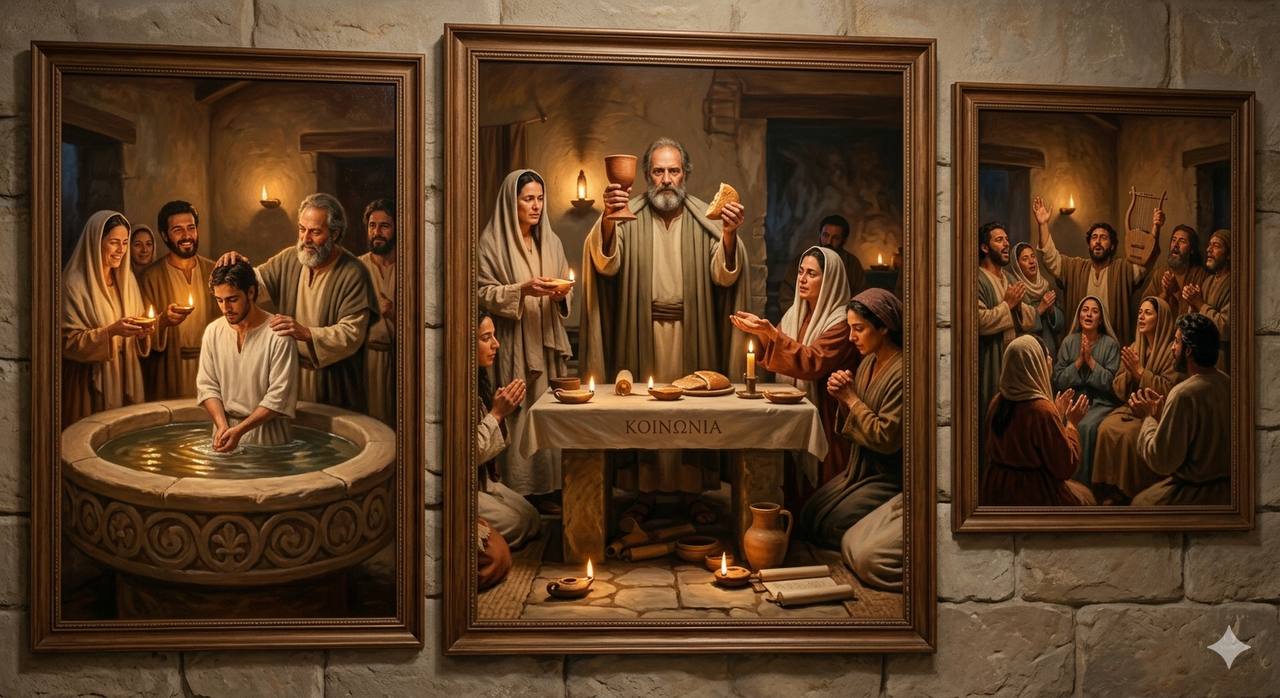
Baptism is not merely a ritual — it is a public declaration that this person has died with Christ and risen with Him to new life.
But more important, in the context of our discussion, is this: every Christian tradition throughout history ties baptism inseparably to membership in a visible local church.
Notice the verb in Acts 2:41, immediately after baptism: “there were added.” Added — to what? To the community. In the New Testament, baptism and joining the community are two events that cannot be separated from each other.
The Testimony of Different Christian Traditions:
Eastern Orthodox: Baptism is “the door into the Church” — it has no meaning outside the community.
Coptic Orthodox: Baptism is immediately followed by the Sacrament of Chrismation and participation in the Eucharist — three inseparable sacraments of entry into the local body.
Reformed Tradition: Calvin stated: “Baptism ought not to be administered except in the Church, for it defines membership in the Church.”
Baptist Tradition: Baptism expresses personal faith prior to formal membership in the local church. But the membership itself remains necessary and obligatory.
There is not a single Christian tradition throughout history that conceives of the possibility of a person being baptized and then living their Christian life detached from an organized local community of believers.
II. The Lord’s Supper — An Ordinance for a Continuing Community
"For I received from the Lord what I also delivered to you, that the Lord Jesus on the night when he was betrayed took bread..."
— 1 Corinthians 11:23
The Lord’s Supper is an ordinance instituted by the Lord Jesus himself. But something occurs today that gives us pause: a group of young people gather together for a ministry or a camp for two months — then at the end they “break bread” and say: “We are celebrating the Lord’s Supper together.” Then the gathering disperses and perhaps they never meet again.
Three Reasons This Is a Real Problem:
First: The absence of ecclesial order — the Lord’s Supper requires ecclesial authority. Who plays the role of the pastor in preventing those who ought not to participate?
Second: The absence of continuity — “Let a person examine himself” (1 Cor. 11:28). This self-examination requires a community that knows the person and bears witness to his life — not a group that gathered for two months.
Third: A shift in meaning — the Lord’s Supper is transformed from a sacred ordinance declaring membership in the visible body of Christ, into a beautiful personal spiritual experience expressing the feelings of the moment.
Voices from Different Traditions:
“The Lord’s Supper is the moment in which the local church declares the identity of its members — who is inside the body and who is outside it.” — Jonathan Leeman
“Let no one hold the Eucharist or offer prayer apart from the bishop.” — Ignatius of Antioch, early second century
“The Holy Supper is the food of God’s children within God’s house — not a light meal shared by travelers on their way before they part.” — John Calvin
Conclusion: Why Does This Matter?
Practicing the breaking of bread and baptism outside the framework of a recognized local church does not merely confuse identity — it produces a real schism within the body of Christ.
The two ordinances together proclaim one truth: that the Christian life is a life in a body, in a community, in belonging. And this community has a name: the local church.
"So those who received his word were baptized, and there were added that day about three thousand souls."
— Acts 2:41
Also Read:
Enjoyed this article?
Get new reflections delivered to your inbox every week.