Psalm 5: My Morning Resolution
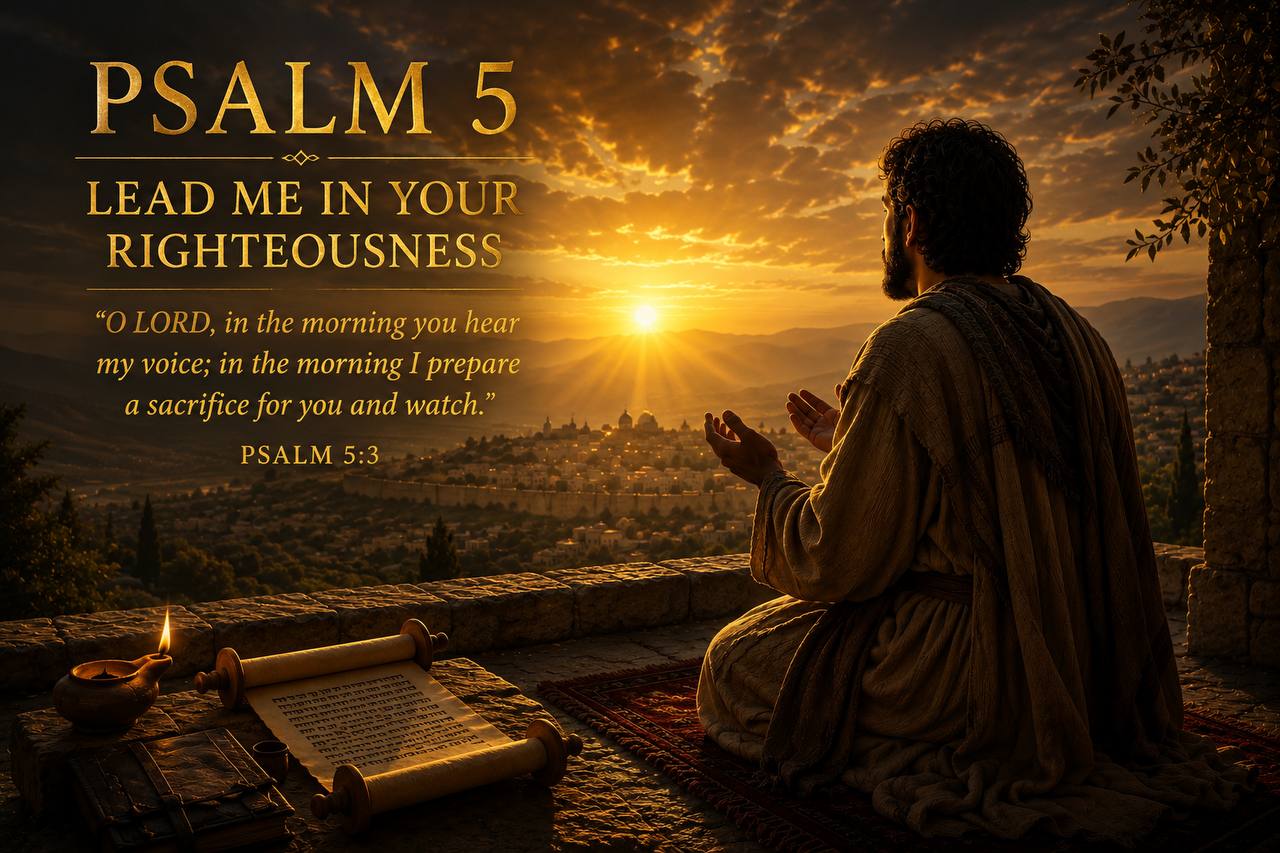
🌿 The Psalm Journey — Psalm 5
My Morning Resolution
Introduction
Last week, Psalm 4 gave us the evening prayer.
A troubled heart, quieted before God. A man lying down in peace not because the storm had ended — but because the Father was near.
Psalm 5 brings us back to the morning.
David wakes before the day begins, before the voices return, before the pressures of life settle back onto his shoulders. And the first thing he does is turn his face toward God.
Psalm 4 taught us how to rest at night.
Psalm 5 teaches us how to begin the day.
The storm is real. But He is faithful, and in the morning, He hears my voice.
A Note on the Setting
The title tells us this psalm was written to the choirmaster, for the flutes.
Like Psalm 4, this is not merely a private prayer. It is worship. A song given to the people of God so they too could pray it in their own moments of fear, betrayal, and uncertainty.
Some of the early church fathers believed Psalm 5 was connected to the betrayal of Ahithophel — David’s trusted counselor who joined Absalom’s rebellion. The betrayal of someone close cuts deeper than the attack of an enemy.
And yet David does not begin the morning with revenge.
He begins with prayer.
Introduction to the Psalm
Psalm 5 is one of the Psalms of Innocence.
Not because David believed he was sinless, but because he was seeking refuge in God rather than joining the evil around him. He approaches God not boasting in his own righteousness but clinging to God’s mercy.
That distinction matters.
David is not saying:
“Look how good I am.”
He is saying:
“Lead me in Your righteousness.”
This psalm is filled with the pain of words:
deception, flattery, betrayal, lies, hidden malice.
But David refuses to answer darkness with darkness.
Instead, he turns toward God — early, intentionally, expectantly.
1. The Cry: “Give Ear to My Words” (Psalm 5:1–2)
“Give ear to my words, O LORD; consider my groaning. Give attention to the sound of my cry, my King and my God, for to you do I pray.”
Notice the repetition:
Give ear. Consider. Give attention.
This is not empty repetition. It is the language of deep need. David keeps circling around the same cry because he cannot let it go.
But the center of the prayer is not the problem.
It is God.
“My King and my God, for to you do I pray.”
David genuinely believes he is speaking to Someone who hears him.
R.A. Torrey once wrote that much of what we call prayer is not truly directed toward God at all. We rehearse anxieties, list concerns, and speak words into the air. But real prayer consciously approaches the living God.²
David prays like a man standing before a King.
And that changes everything.
2. The Morning Appointment (Psalm 5:3)
“O LORD, in the morning you hear my voice; in the morning I prepare a sacrifice for you and watch.”
This verse carries remarkable intentionality.
David is not describing a passing spiritual feeling. He is describing a rhythm and a habitual lifestyle.
In the morning, I will come before You. You will see me there.
He made his resolution. Before the noise of the world rises, David gives God the first word.
Two things happen before David prays. One thing happens after.
Before — he directs his prayer. The Hebrew word carries the idea of arranging wood upon an altar before a sacrifice is lit. David is not wandering casually into God’s presence with scattered thoughts and a distracted heart. He is ordering. Arranging. Preparing. His prayer has intention before it has words.
Before — he orders his time with God. This is not haphazard. F.B. Meyer wrote: *“It is manifestly a mistake to pray at haphazard. There is too much random praying with us all. We do not return again and again to the same petition, pressing it home with all humility and reverence, arguing the case as Abraham did for the cities of the plain.”*³
After — he watches.
“I watch.”
He waits expectantly for God to move. Not passively. Actively. He has laid his sacrifice on the altar. Now he steps back and trusts God to answer. Not because he deserves a response.
But because God is faithful to those who call on His name.
That is faith.
Not merely speaking to God — but believing He answers.
Jesus Himself lived this way.
“And rising very early in the morning, while it was still dark, he departed and went out to a desolate place, and there he prayed.” (Mark 1:35)
Spurgeon wrote: *“While the dew is on the grass, let grace drop upon the soul.”*¹
3. The Character of God (Psalm 5:4–6)
“For you are not a God who delights in wickedness; evil may not dwell with you. The boastful shall not stand before your eyes; you hate all evildoers. You destroy those who speak lies; the LORD abhors the bloodthirsty and deceitful man.”
David anchors his prayer in the character of God.
God is not indifferent to evil. He is not neutral toward sin. Holiness matters to Him.
But Psalm 5 holds together two truths we must never separate:
God is holy. And God is merciful.
If we speak only of God’s love while ignoring His holiness, we distort Him. If we speak only of judgment while ignoring His mercy, we distort Him again.
The beauty of the Gospel is that both are held together in Christ. At the cross, God’s holiness and His loving mercy meet perfectly.
St. Augustine said that the judgments in the Psalms are often not personal revenge, but prophecy — the natural outcome of rebellion against God. Sin carries destruction within itself.⁴
David is not asking permission to hate people.
He is entrusting justice to God instead of taking it into his own hands.
But can we actually pray these prayers today?
Yes — but only when we understand what they are. The imprecatory psalms are not the prayers of a man taking revenge. They are the prayers of a man surrendering judgment. Timothy Keller put it simply: David is saying “I will not destroy you myself. I will place you before the just Judge and trust Him to act.” That is not vengeance. That is faith.⁵
John Piper adds a deeper dimension still — David is not ultimately praying for his own vindication. He is praying for God’s glory. “You are a just God — be just.” The motivation is not personal satisfaction. It is the honour of God’s name.⁶
4. Through Your Steadfast Love (Psalm 5:7–8)
“But I, through the abundance of your steadfast love, will enter your house. I will bow down toward your holy temple in the fear of you. Lead me, O LORD, in your righteousness because of my enemies; make your way straight before me.”
That word again:
But.
The wicked cannot stand before God.
But I…
Not because David deserves it. Not because he is morally superior.
But because of God’s steadfast love.
The Hebrew word here is hesed — covenant love, loyal mercy, faithful kindness that does not let go.
David’s confidence is entirely rooted in God’s character.
And so he bows before God in worship:
“I will bow down toward your holy temple in the fear of you.”
The closer we draw to God, the more clearly we see both:
His holiness, and our need for mercy.
And from that posture David prays:
“Lead me, O LORD, in your righteousness.”
This may be the heart of the entire psalm.
David does not ask God merely to remove his enemies. He asks God to lead him rightly in the middle of them.
That is spiritual maturity.
Morning prayer is not simply asking God to bless our plans.
It is surrendering the day before it begins.
5. Two Paths, Two Voices (Psalm 5:9–12)
“For there is no truth in their mouth; their inmost self is destruction; their throat is an open grave; they flatter with their tongue. Make them bear their guilt, O God; let them fall by their own counsels; because of the abundance of their transgressions cast them out, for they have rebelled against you. But let all who take refuge in you rejoice; let them ever sing for joy, and spread your protection over them, that those who love your name may exult in you. For you bless the righteous, O LORD; you cover him with favor as with a shield.”
David ends the psalm by contrasting two groups:
those who rebel against God, and those who take refuge in Him.
The wicked are marked by deception:
“There is no truth in their mouth.”
Their speech reveals their hearts.
Jesus later echoed this same truth:
“Out of the abundance of the heart the mouth speaks.” (Matthew 12:34)
David does not retaliate with violence or manipulation. He places judgment into God’s hands.
As Keller observed, the imprecatory psalms are acts of surrender rather than revenge. David is not saying “hurt them because they hurt me.” He is placing them before the just Judge and stepping back. That requires more trust than retaliation ever does.⁵
David is saying:
“I will not take revenge myself. I will trust the Judge of all the earth.”
And then the tone changes completely.
“But let all who take refuge in you rejoice.”
Three times David speaks of joy:
rejoice, sing for joy, exult.
This joy is not based on circumstances. David is still surrounded by enemies. The crisis has not disappeared.
But refuge produces joy deeper than circumstances.
And then comes the final image:
“You cover him with favor as with a shield.”
Not a small shield.
A surrounding shield.
God’s favor becomes protection for His people.
6. Seeing Jesus in Psalm 5
Psalm 5 ultimately points us beyond David to Christ.
Jesus is the true righteous King. (Jeremiah 23:5)
Jesus rose early to pray before the Father. (Mark 1:35)
Jesus perfectly trusted the Father in the face of betrayal. (Luke 23:46)
Jesus is the abundance of steadfast love David longed for. (Romans 5:8)
Jesus became our righteousness. (2 Corinthians 5:21)
Jesus is our refuge and shield. (Hebrews 6:18)
What David prayed for, Christ fulfilled.
And because of Him, we too may come before the Father in confidence.
7. A Missional Reflection
Psalm 5 asks us a searching question before the day begins:
Who gets the first word in your morning?
David shows us what it looks like to begin the day by turning his face toward God — ordering his prayer, offering his worship, and then watching expectantly for God to move. Not because he deserves an answer, but because God is faithful.
And as followers of Jesus, we do not begin the morning only for ourselves.
We are part of God’s mission in the world.
The joy, refuge, and security David describes are not meant to stop with us. The world is filled with people waking up anxious, weary, restless, and spiritually homeless. Psalm 5 reminds us that there is still a place of refuge under the favor of God.
That means our mornings are missional.
As we pray, worship, and walk with God, we become witnesses to a different kingdom — a people who know where true joy is found. The church becomes a community of refuge, reflecting the heart of God to a world searching for shelter.
Who can you encourage this week?
Who around you needs to hear that God still listens, still leads, and still receives those who come to Him?
Psalm 5 cries out for justice. Romans 12:19 reminds us that vengeance belongs to God alone. Jesus calls us even further — to love our enemies and pray for those who persecute us. But that is not the end of the story. Revelation 6:10 and 20:11–15 assure us that the just Judge will one day make all things right. The wicked will not stand forever. Justice will come — not by our hand, but by His. Until that day, we entrust our wounds to God, we love even our enemies, and we wait expectantly for the return of the righteous King.
And if you do not yet know Jesus personally, Psalm 5 leaves you with an invitation.
The shelter David speaks about is not reserved for perfect people. David himself was weak, broken, and in desperate need of mercy. He entered God’s presence only through the abundance of God’s steadfast love.
That same invitation stands open today through Jesus Christ.
Come to Him. Put your trust in Him. Bring Him your fears, your sin, your weariness, and your wandering heart. The God who heard David’s morning prayer still hears those who call upon Him today. In Christ, there is forgiveness, refuge, and peace for all who come.
You do not have to remain outside the shelter of God. The door of refuge is still open.
For you bless the righteous, O LORD; you cover him with favor as with a shield. 🌿
Next week we continue the Psalm Journey — Psalm 6: O LORD, Rebuke Me Not in Your Anger. David’s darkest night — where tears become prayer, and where mercy meets a weary soul before the morning comes.
📖 Want to understand the different types of psalms and find similar reflections? Visit the Psalm Types Guide →
📖 Psalm 5 is a Lament Psalm — explore all lament psalms →
Also Read:
Sources
¹ Charles H. Spurgeon, The Treasury of David, Vol. 1: Psalms 1–26 (London: Passmore and Alabaster, 1870), on Psalm 5:3.
² R.A. Torrey, How to Pray (Chicago: Moody Press, 1900).
³ F.B. Meyer, Through the Bible Day by Day, Vol. 3 (Philadelphia: American Sunday School Union, 1914).
⁴ St. Augustine, reflections on Psalm 5 in patristic commentaries.
⁵ Timothy Keller, The Songs of Jesus (New York: Viking, 2015).
⁶ John Piper, sermon series on the Psalms, desiringgod.org.
⁷ David Guzik, Commentary on Psalm 5, Enduring Word Bible Commentary, enduringword.com.
⁸ Father Tadros Yacoub Malaty, تفسير سفر المزامير — المزمور الخامس (Commentary on the Book of Psalms: Psalm 5), published on St. Takla Haymanout Coptic Orthodox Website, st-takla.org.
Enjoyed this article?
Get new reflections delivered to your inbox every week.