Psalm 4: In Peace I Will Lie Down and Sleep
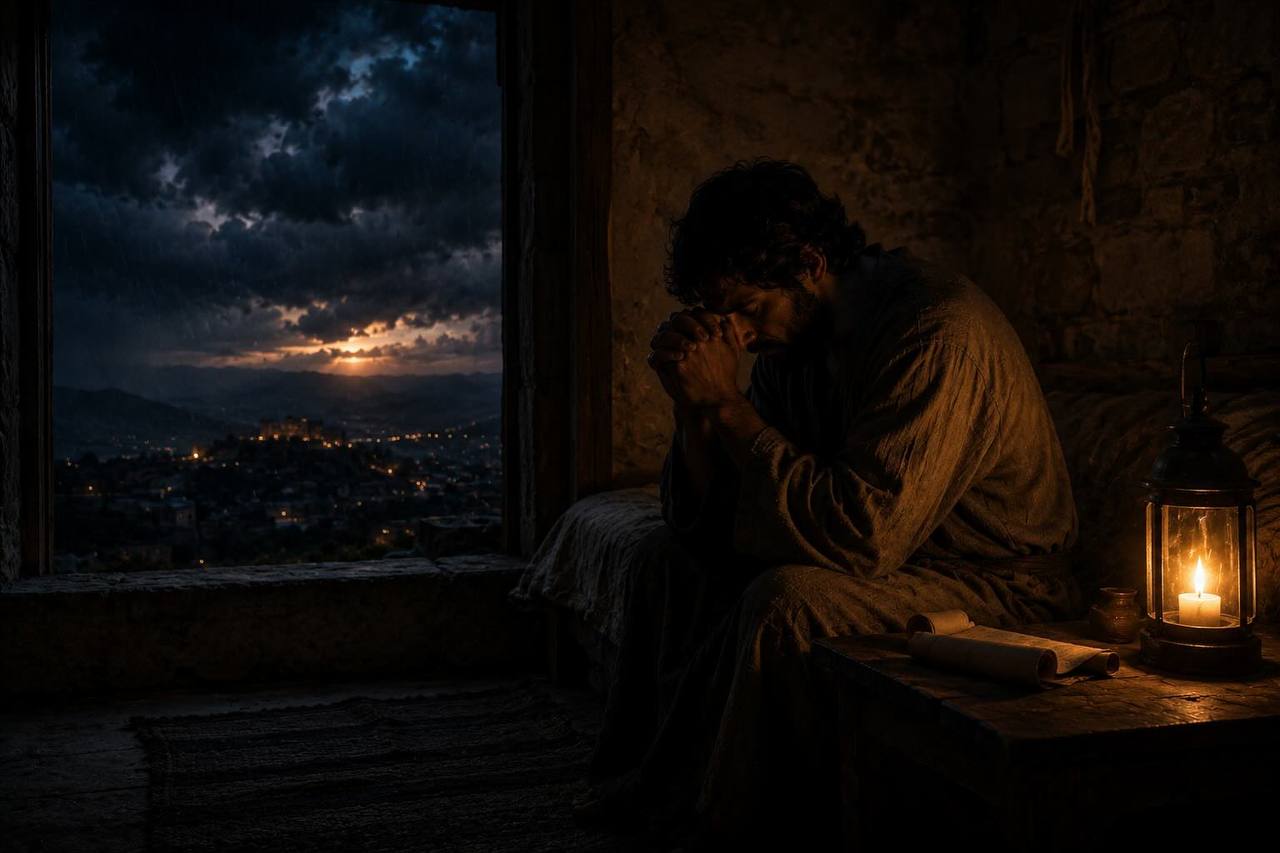
🌿 The Psalm Journey — Psalm 4
In Peace I Will Lie Down and Sleep
Introduction
Last week, Psalm 3 gave us a morning prayer.
A man on the run. A king without a throne. A father fleeing from his own son.
And yet — from inside that storm — David laid down and slept.
“I lay down and slept; I woke again, for the LORD sustained me.”
This week, Psalm 4 gives us the companion to that morning prayer.
The evening prayer.
Psalm 3 was the dawn. Psalm 4 is the dusk.
And if Psalm 3 taught us what to do when the storm arrives — Psalm 4 teaches us how to rest when the storm has not yet passed.
Life is hard, but God is good — and in peace I will lie down and sleep.
A Note on the Setting
The title tells us this psalm was written to the choirmaster, with stringed instruments.
This is not a private cry in the wilderness.
This is a song. Intentionally composed. Given to the choir. Meant to be sung by others who find themselves in the same place David found himself.
That matters.
David is not just processing his pain — he is turning it into worship. He is handing his darkest evening to the choirmaster and saying: someone else will need this song.
The night is real. But it is also worship material.
Introduction to the Psalm
Psalm 3 and Psalm 4 are connected.
Same storm. Same David. Same crisis — Absalom’s coup, the betrayal, the flight from Jerusalem. But different moments.
Psalm 3 is the cry at daybreak. Psalm 4 is the prayer at nightfall.
And the night is its own kind of battle.
When the day ends and the darkness comes, the mind begins to replay everything. The voices return. The worries crowd back in.
The problems that seemed manageable in the morning feel heavier at midnight.
Every unanswered question. Every unresolved conflict. Every fear about tomorrow — they all come alive when the lights go out.
David knows this.
And Psalm 4 is his answer to the night.
This psalm paints an unmistakable picture of David’s reliance on God’s justice and mercy in the face of adversity.
What is remarkable is not only what David says, but what he refuses to say.
He does not accuse God. He does not demand explanations. He entrusts himself to the God whose hand he cannot fully trace.
Pope Athanasius the Apostolic observed something beautiful here — that the word David uses, “you have given me relief,” can literally be translated as “you have enlarged me” or “you have created a spacious room for me.”
Even in distress, God was not shrinking David’s world. He was expanding it.¹
That is a different kind of faith. Not the faith that demands God explain Himself. But the faith that trusts His hand even when it cannot trace it.
1. The Cry: Answer Me When I Call (Psalm 4:1)
“Answer me when I call, O God of my righteousness! You have given me relief when I was in distress. Be gracious to me and hear my prayer!”
Feel the weight of that opening line.
Not a polite request. A cry.
Answer me when I call.
You can hear in David’s voice the sound of desperate need — a man who has placed everything in one place and is saying: if God does not come through for me, I am done.
He is my only hope. I have nobody else to go to.
This is not the prayer of a man with backup plans. This is total, unguarded dependence on God alone.
But notice who he is crying out to.
“O God of my righteousness.”
This phrase stopped Spurgeon in his tracks. He explained it this way:
“It means, Thou art the author, the witness, the maintainer, the judge, and the rewarder of my righteousness; to thee I appeal from the calumnies and harsh judgments of men. Herein is wisdom, let us imitate it and always take our suit, not to the petty courts of human opinion, but into the superior court, the King’s Bench of heaven.” (The Treasury of David, Vol. 1, p. 34)²
David is not claiming to be righteous in himself.
He knew better than anyone that his righteousness came from God, not from his own merit — Psalm 51 makes that unmistakably clear.
He is appealing to God as the one who makes him righteous.
He is not standing before God saying “Look at what I deserve.”
He is standing before God saying “Look at who You are.”
That is a very different prayer.
And then he reaches into his history.
“You have given me relief when I was in distress.”
Imagine someone drowning in deep water. The panic. The thrashing. The body struggling against something it cannot fight for long.
At some point, the strength runs out. The only way out is for someone else to reach in and pull you to safety.
You do not save yourself. You are saved.
That is the word David uses here. Distress — a tight place, a narrow place, a place of constriction and suffocation.
And he says: in that place, You enlarged me. You made room.
As Spurgeon observed: *“This is another instance of David’s common habit of pleading past mercies as a ground for present favour.”*²
He is not just remembering. He is arguing.
He is saying: Lord, You have done this before. There is no reason You will not do it again.
His past with God becomes the fuel of his faith in the present.
2. The Question: How Long? (Psalm 4:2–3)
“O men, how long shall my honor be turned into shame? How long will you love vain words and seek after lies? Selah. But know that the LORD has set apart the godly for himself; the LORD hears when I call to him.”
David turns from praying to God — and addresses the people directly.
How long?
He is not afraid of them. He is not pleading with them. He is asking them to think. To pause. To consider what they are actually doing.
How long will you follow lies and love vain words?
And then — that word again.
But.
As in Psalm 3, this single transitional word carries the entire weight of David’s confidence.
The reality around him says: you are done. Your honor is gone. You have lost.
But David knows God is still in the picture. God has not stepped back. God has not abandoned His anointed.
And he gives two reasons for his trust.
First: The LORD has set apart the godly for himself.
Matthew the Poor draws our attention to the Hebrew word behind this — hesed.
It encompasses mercy, lovingkindness, steadfast love, and covenant loyalty. It describes someone who is in a relationship of allegiance with God — and who is also the receiver of that same loyal, covenantal love in return.³
The LORD sets His people apart for Himself. Not for their achievement. Not for their performance. But for His glory and for the enjoyment of that mutual, covenantal love.
David knew he had not chosen to be king. God had anointed him.
And those who had taken his throne by force and evil scheming were not merely opposing David — they were standing against God and His anointed.
That is why David does not fight back. He does not argue his case before men. He argues his case before God.
Because this is not his battle. It is God’s.
Second: The LORD hears when I call to him.
Those who belong to the Lord and walk in covenant relationship with Him can call upon Him with confidence.
David is confident — not arrogant, but quietly certain — that when he calls, God listens.
Because God is faithful to His children. Because He is near to those who call on Him with all their heart.
3. The Self-Talk: Be Angry, and Do Not Sin (Psalm 4:4–5)
“Be angry, and do not sin; ponder in your own hearts on your beds and be silent. Selah. Offer right sacrifices and put your trust in the LORD.”
This is one of the most honest moments in the entire psalm.
David is angry. He does not pretend otherwise.
The situation is unjust. His honor has been turned to shame. His own son has betrayed him. His closest friends have turned against him.
He has every reason to be angry.
But he preaches to himself.
Be angry — and do not sin.
He is warning himself. Do not let this anger become hatred. Do not let it become bitterness. Do not let it become a hunger for revenge.
Surrender to the One who judges justly and let Him settle the account.
St. John Chrysostom said it with precision:
“Let your mouth have a door, which closes when necessary, and let it be supported by a firm bolt, so that nothing can provoke your voice to anger, nor can you return corruption with corruption — for today you have heard what is dictated to your ears: ‘Be angry and do not sin.’”⁴
And then David commands himself to be silent.
Ponder in your own hearts on your beds and be silent.
St. John Cassian adds:
“In the night we can always remember, for the soul is quiet in rest. In the evening, under a clear sky, we are stretched out on our beds, where no one interrupts our thinking. Let us hold ourselves accountable for everything we have said or done during the day.”⁴
Pope Shenouda III captured this same spirit of night prayer in one of his most beloved poems:
Enter your chamber and kneel down, Pour out your soul completely bare, Tell Him: the burden has grown heavy, The way has narrowed — open wide the door.
Tell Him: Lord, I am too weak, I have no strength left to carry on, Lay your burden before Him and wrestle, In the darkness of the night — with Jesus.
Fill the night with prayer, *With wrestling, and with tears.*⁵
This is not emptying the mind. This is filling it.
David is not practising the kind of meditation that disconnects from reality, that reaches inward for some undefined inner peace, that looks to nature or to self.
He is telling himself: fill your heart with the Word of God. Remember His laws. Remember His past mercies. Remember His goodness.
And then be still. Let that truth sink deeply. Let it anchor your shaking heart.
This is Psalm 1 lived out in real time.
And after that honest, searching pause — he says:
Offer right sacrifices and put your trust in the LORD.
David knew he needed the right heart posture before he could offer anything to God. So he examined himself first.
And then — whether or not the situation had changed, whether or not relief was visible — he chose to worship anyway.
Keep offering. Keep trusting. He is faithful. He is God. And you are not.
4. The Choice: Joy Instead of Despair (Psalm 4:6–7)
“There are many who say, ‘Who will show us some good? Lift up the light of your face upon us, O LORD!’ You have put more joy in my heart than they have when their grain and wine abound.”
David hears the voices around him.
People are asking — who will show us anything good?
Where is the goodness in this? Can anything good come out of this situation?
He does not dismiss those voices. He does not argue with them. He does not tell them they are wrong.
The situation is genuinely dark. The question is legitimate. Perhaps the situation itself was shouting that question loudly in David’s own face.
But he does not follow those voices into despair.
He turns his face upward.
“Lift up the light of your face upon us, O LORD.”
He may be reaching for the ancient Aaronic blessing — that prayer given to Moses to speak over the people:
“The LORD bless you and keep you; the LORD make His face shine upon you, and be gracious to you; the LORD lift up His countenance upon you, and give you peace.” (Numbers 6:24–26)
When you have been walking in darkness for a long time, it is like being inside a tunnel with no visible end.
You don’t know how long it goes. You don’t even know if it ends.
And in that place of deep despair — all your heart needs is to see a light.
Not arrival. Just light. Even from far away. Just enough to know: there is a way through.
David is asking for that light.
And then — remarkably — he says he already has it.
“You have put more joy in my heart than they have when their grain and wine abound.”
The situation has not changed. The enemies are still there. Absalom still sits on the throne in Jerusalem. The road ahead is still uncertain.
But David has joy.
Not because of what he has. But because of what God has placed inside him.
A joy that does not depend on harvest. A gladness that does not rise and fall with circumstances. More sustaining than wheat. More strengthening than wine.
A gift placed directly in the heart by God Himself.
Your joy, Lord, sustains me more than anything they are celebrating out there.
5. The Rest: In Peace I Will Lie Down and Sleep (Psalm 4:8)
“In peace I will both lie down and sleep; for you alone, O LORD, make me dwell in safety.”
The psalm ends here. And it ends beautifully.
The troubled heart — examined, quieted, searched, offered to God — is now at rest.
David is like a child in the mighty arms of his father.
Things are still troubling around him. He is still the target of the ungodly who want to hunt him down. The tension of war and fear is still real.
But he is in the arms of the Lord Almighty — and that has led his heart to peace.
Nothing could steal it from him. Not people. Not enemies. Not the storm raging inside or outside.
He lies down. And he sleeps.
G. Campbell Morgan captures the meaning of the word alone in this verse with unusual beauty:
“The thought of the word alone is ‘in loneliness,’ or ‘in seclusion’; and the word refers to the one going asleep. This is a glorious conception of sleep. Jehovah gathers the trusting soul into a place of safety by taking it away from all the things which trouble or harass… the tried and tired child of His love is pavilioned in His peace.”⁶
Alone with God. Secluded in His presence. Safe not because the danger is gone — but because the Father is near.
There is an old Coptic hymn that holds this same truth:
“Close the door and wrestle in the darkness with Jesus.”
That is the prayer of Psalm 4. Not the prayer of someone whose problems are solved.
The prayer of someone who has chosen — in the middle of an unsolved night — to close the door, to be alone with God, and to rest in His arms until morning.
6. Seeing Jesus in Psalm 4
Psalm 4 ultimately points us beyond David — to the One greater than David.
Jesus is the God of our righteousness. Not the one who merely declares us righteous from a distance — but the one who became our righteousness. What David appealed to as a gift, Jesus fulfilled as the Giver.
Jesus prayed in the night. In Gethsemane, He faced the darkest evening any human being has ever faced — and He turned His face to the Father. “Not my will, but Yours.” That is Psalm 4 lived to its fullest.
Jesus was set apart by the Father. Not by His own ambition. Not by human appointment. The Father anointed Him — and those who opposed Him were opposing the Father Himself.
Jesus lay down in peace. On the cross, at the moment of His death, He said “Into Your hands I commit my spirit.” That is the ultimate act of lying down in safety — entrusting the soul completely to the Father.
And He rose. The Father did not leave Him in the darkness. The morning came. And because it came for Jesus — it will come for us.
7. A Missional Reflection
Tonight — what is keeping you awake?
What voices are replaying in your mind? What worries are crowding back in now that the day is done? What fears are heavier in the dark than they were in the light?
Psalm 4 does not promise that the night will be short.
It promises something better.
It promises that you are not alone in it.
Preach to yourself tonight the way David did. Be honest about the anger, the pain, the injustice. Examine your heart. Offer what you have to God — even if it is broken, even if you are not sure the situation will change. Ask for the light of His face. And then lie down.
Not because everything is resolved.
But because He alone makes you dwell in safety.
When the world around us is asking “Who will show us any good?” — and we have genuine joy that has nothing to do with our circumstances — that joy becomes one of the most powerful witnesses we can offer. Not an argument. Not a program. Just a life that makes no sense apart from God. The light of His countenance shining through ordinary people in hard times points a broken world toward the only One who can give what they are truly looking for.
Speaking truth and standing for what is right in a culture moving the opposite direction invites real opposition. And the temptation is to carry the weight of the outcome yourself. But Psalm 4 reminds us — the mission belongs to God, not to us. When we truly believe that, we can do what David did. Lie down. Sleep. That is the rest Psalm 4 is inviting us into. Not the rest of someone who has finished — but the rest of someone who knows who has.
And if you do not yet know the God who hears when you call — this psalm is for you too. Because the same God who heard David in his darkest night is the same God who is listening right now.
Call to Him.
He answers.
In peace I will both lie down and sleep; for you alone, O LORD, make me dwell in safety. 🌿
📖 Want to understand the different types of psalms and find similar reflections? Visit the Psalm Types Guide →
📖 Psalm 4 is a Psalm of Lament and Trust — explore all trust psalms →
Next week we continue the Psalm Journey — Psalm 6: A cry from the depths when the soul is overwhelmed.
Also Read:
Sources
¹ Pope Athanasius the Apostolic, The Book of Psalms — Commentary.
² Charles H. Spurgeon, The Treasury of David, Vol. 1: Psalms 1–26 (London: Passmore and Alabaster, 1870), on Psalm 4.
³ Matthew the Poor, Commentary on the Psalms.
⁴ St. John Chrysostom and St. John Cassian, Patristic Commentary on Psalm 4:4.
⁵ Pope Shenouda III, Prayer — The Way of Life (الصلاة — طريق الحياة). This poem is widely attributed to him in Coptic devotional literature.
⁶ G. Campbell Morgan, The Psalms — A Commentary (Grand Rapids: Kregel Publications), on Psalm 4:8.
Enjoyed this article?
Get new reflections delivered to your inbox every week.