When God's People Prayed and Fasted: Old Testament Witnesses
Introduction
We have walked through the inward journey of fasting.
We have followed Jesus into the wilderness.
We have seen how fasting sends us outward into mission.
But now I want us to stand with the men and women of the Old Testament.
Because fasting was never invented in the New Testament. It runs like a golden thread through the whole story of God’s people.
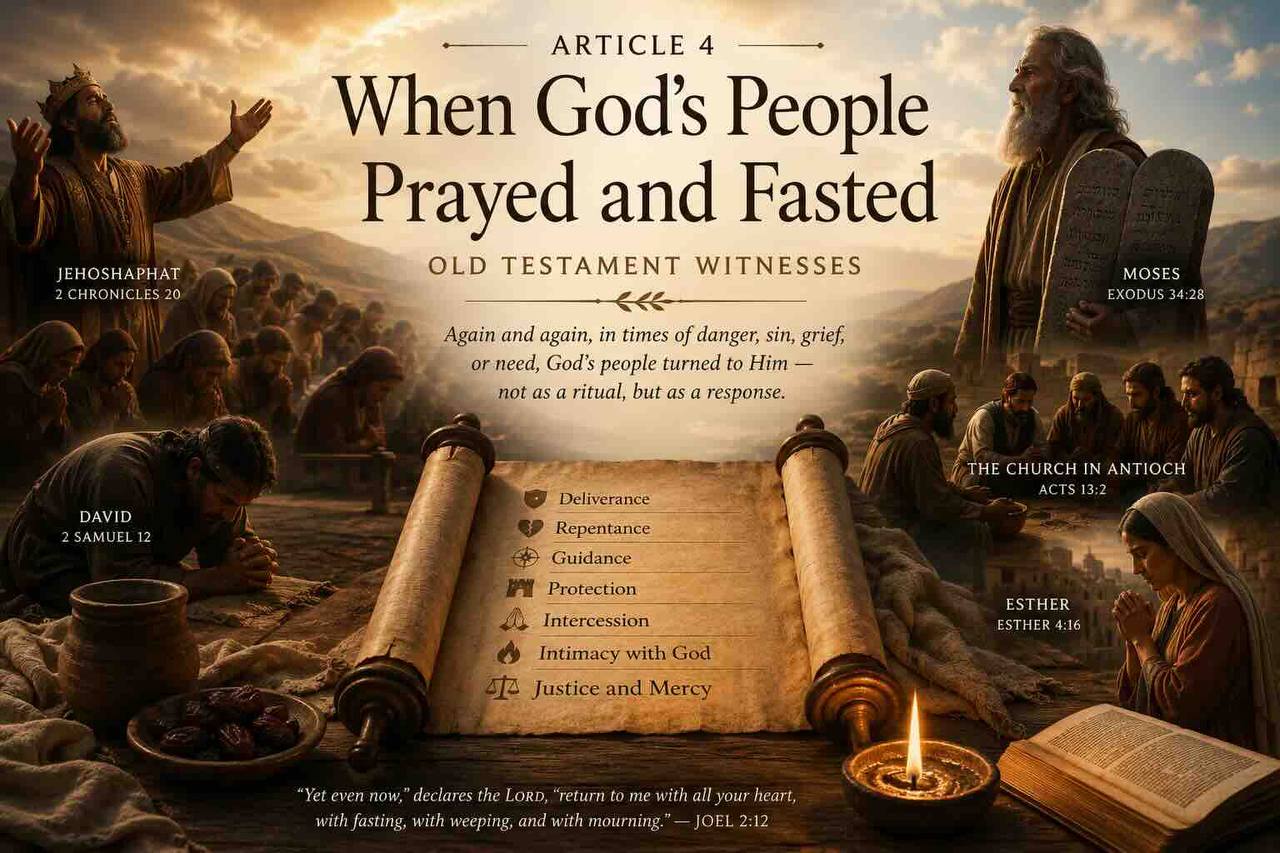
Again and again, when something serious was happening — when danger approached, when sin was exposed, when grief overwhelmed, when guidance was needed — God’s people turned to prayer and fasting.
“Prayer without fasting can be distracted. Fasting without prayer is just hunger. But when prayer and fasting are joined, something shifts. The body joins the cry of the soul. The stomach declares what the lips are saying. Prayer and fasting together become the whole person seeking the living God.”
“I humbled my soul with fasting, and my prayer returned into my own bosom.” (Psalm 35:13, KJV)
Not as a ritual.
Not as a formula.
As a response. It’s the whole being crying out to Him.
Let us walk through their stories together.
Fasting in Crisis — Eyes on God
Jehoshaphat and Deliverance (2 Chronicles 20)
Perhaps no Old Testament story captures the heart of fasting more clearly than the story of Jehoshaphat.
A vast enemy army was approaching Judah.
The situation was impossible.
And Scripture says:
“Then Jehoshaphat was afraid and set his face to seek the LORD, and proclaimed a fast throughout all Judah.” (2 Chronicles 20:3, ESV)
Notice the honesty of the passage.
Jehoshaphat was afraid.
Fear itself was not the failure.
The question was where fear would drive him.
And Jehoshaphat let fear drive him toward God.
The people gathered.
They prayed.
They fasted.
And Jehoshaphat prayed one of the most honest prayers in Scripture:
“We do not know what to do, but our eyes are on you.” (2 Chronicles 20:12, ESV)
That is fasting.
It does not first give us a strategy.
It gives us eyes on God.
And the Lord answered:
“Do not be afraid and do not be dismayed… for the battle is not yours but God’s.” (2 Chronicles 20:15, ESV)
Fasting did not manipulate God.
It positioned the people in dependence.
Esther and Protection (Esther 4)
Centuries later, another crisis emerged.
The Jewish people faced destruction.
And Esther sent word:
“Go, gather all the Jews… and hold a fast on my behalf.” (Esther 4:16, ESV)
The whole community fasted.
And God preserved His people.
Again, fasting became the language of dependence in a moment of danger.
Ezra and the Dangerous Journey (Ezra 8)
Before leading the people safely back to Jerusalem, Ezra proclaimed a fast:
“That we might humble ourselves before our God, to seek from him a safe journey.” (Ezra 8:21, ESV)
Ezra understood something important.
Sometimes God’s people must choose dependence over visible security.
Reflection:
Again and again, fasting appears in moments when God’s people realise they cannot save themselves.
Fasting becomes the physical confession:
Lord, we need You.
Fasting in Repentance — Returning to God
David’s Broken Prayer (2 Samuel 12)
After David sinned with Bathsheba and the child became sick, Scripture says:
“David therefore sought God on behalf of the child. And David fasted.” (2 Samuel 12:16, ESV)
This was not religious performance.
This was grief.
Brokenness.
Repentance.
And though the child eventually died, David’s fasting still mattered.
Because fasting does not guarantee the outcome we want.
But it brings us honestly before God.
Joel — Rend Your Hearts (Joel 2)
The prophet Joel called the people to return to God:
“Return to me with all your heart, with fasting, with weeping, and with mourning.” (Joel 2:12, ESV)
But Joel immediately clarifies:
“Rend your hearts and not your garments.” (Joel 2:13, ESV)
True fasting is not outward drama.
It is inward surrender.
Daniel’s Prayer of Confession (Daniel 9)
Daniel prayed and fasted not only for his own sins but for the sins of his people:
“We have sinned and done wrong and acted wickedly.” (Daniel 9:5, ESV)
Biblical fasting often moves beyond personal repentance into intercession for others.
Nineveh — The Fast of a Pagan City (Jonah 3)
Even Nineveh fasted.
From the king to the common people, the city humbled itself before God.
And God responded with mercy.
What a remarkable picture.
Fasting is not about perfection.
It is about humility.
Reflection:
Throughout Scripture, fasting often accompanies repentance because fasting humbles the soul.
It slows us down enough to face the truth about ourselves before God.
Fasting for Revelation, Guidance, and Mission
Moses on the Mountain (Exodus 34)
Moses fasted forty days in the presence of God:
“He neither ate bread nor drank water.” (Exodus 34:28, ESV)
And there, God gave him the words of the covenant.
Fasting does not force God to speak.
But it positions us to listen.
Anna’s Life of Devotion (Luke 2)
Anna the prophetess:
“Did not depart from the temple, worshiping with fasting and prayer night and day.” (Luke 2:37, ESV)
Her life reminds us that fasting is not merely for crisis.
It can become part of a life shaped by longing for God.
Before Ministry and Leadership
Jesus fasted before public ministry.
The church fasted before sending missionaries in Acts 13.
Paul and Barnabas prayed and fasted before appointing elders in Acts 14.
Again and again, fasting appears before moments requiring wisdom, discernment, and obedience.
Reflection:
Fasting often appears wherever God’s people recognise their need for guidance.
The quieter the soul becomes, the more clearly it can listen.
The Fast God Rejects — Isaiah 58 and Jeremiah 14
Not all fasting pleases God.
This may be one of the most sobering truths in Scripture.
In Isaiah 58, the people complained that God seemed distant despite their fasting.
But God answered:
“Behold, in the day of your fast you seek your own pleasure.” (Isaiah 58:3, ESV)
Their fasting was disconnected from justice.
They oppressed workers.
They fought with one another.
They performed religion while ignoring the poor.
And God responded with strong words.
Then He described the fast He actually desires:
“Is not this the fast that I choose: to loose the bonds of wickedness… to share your bread with the hungry.” (Isaiah 58:6–7, ESV)
The acceptable fast is not merely abstaining from food.
It is a life aligned with the heart of God.
A fasting that opens the hand.
A fasting that pursues justice.
A fasting that loves mercy.
Jeremiah 14 gives a similar warning.
God says:
“Though they fast, I will not hear their cry.” (Jeremiah 14:12, ESV)
Why?
Because their hearts remained far from Him.
Fasting without repentance becomes religious performance.
And God sees beyond performance.
Reflection:
Scripture never presents fasting as magic.
God is not manipulated by empty rituals.
He desires humble hearts.
Open hands.
Lives shaped by justice, mercy, and obedience.
A Final Reflection
What do all these witnesses teach us?
Fasting in Scripture was never an end in itself.
It was always a response.
A response to danger.
A response to grief.
A response to sin.
A response to calling.
A response to weakness.
And ultimately, a response to God Himself.
So let us learn from those who came before us.
Let us fast with honest hearts.
Let us fast with open hands.
Let us fast with eyes fixed on God.
And let us seek the kind of fasting God actually desires — one marked by humility, repentance, justice, dependence, and love.
Because fasting does not earn the favour of God.
It positions us to receive what He is already longing to give.
References
- Scripture: All Scripture quotations are from The Holy Bible, English Standard Version (ESV).
- Piper, John. A Hunger for God. 1997.
Also Read:
- Hunger for God — What Fasting Reveals
- The Wilderness and the Word
- Fasting, Mission, and the Upside-Down Kingdom
- The Importance of Prayer and Fasting
Longing for God — Prayer & Fasting:
Enjoyed this article?
Get new reflections delivered to your inbox every week.