Jesus in the Wilderness — Fasting and Total Dependence on God
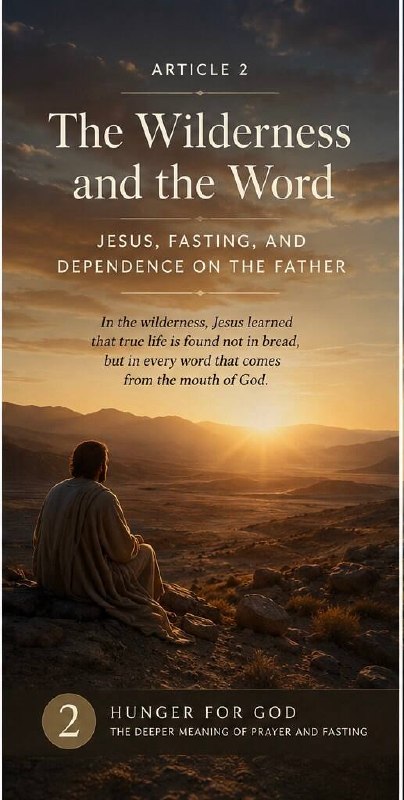
Introduction — Into the Wilderness
In the previous article, we explored how fasting reveals the hidden hungers of the heart.
But Scripture does not leave fasting merely in the realm of introspection.
Again and again, God leads His people into wilderness places.
Places of weakness.
Places of dependence.
Places where false supports collapse.
And nowhere is this seen more clearly than in the life of Jesus Himself.
Jesus in the Wilderness
Matthew 3 ends with glory.
The heavens open.
The Spirit descends.
And the Father declares:
“This is my beloved Son, with whom I am well pleased.” (Matthew 3:17, ESV)
And then immediately afterwards, Matthew tells us:
“Then Jesus was led up by the Spirit into the wilderness to be tempted by the devil.” (Matthew 4:1, ESV)
The Spirit led Him there.
Not punishment.
Preparation.
Not abandonment.
Formation.
Jesus fasted for forty days in the wilderness before stepping into public ministry.
Why?
Jesus in the Desert
Look closely at what happens right after Jesus is baptised. Everything looks amazing. A sunny, shining day. The sky is beautiful, clear, and blue. The Holy Spirit descends on Jesus like a dove. And the voice of the Father speaks — that beautiful, powerful, trembling voice. It sounds like a coronation festival. I am sure even nature was having a feast — the mountains, the birds, and the sea. Everything is celebrating. But then — immediately — Jesus is taken to the desert. To the wilderness.
Sometimes we have a kind of fantasy about the desert, especially if you have never lived in one. I lived in the desert of Egypt for over twelve years, helping to establish a house of prayer. And I learnt something there that I could not learn anywhere else — my own weakness and God’s strange faithfulness in barren places.
And I tell you — it is not fun. The desert is a reflection of barrenness. No life. The weather is ridiculously harsh. The heat is scorching. And when a sandstorm comes, that is a different experience entirely. In the wilderness, you are exhausted, tired, and weak. You are vulnerable to the attack of the enemy. And most importantly, you ask yourself: Why am I here? Nothing good could come out of the desert. And yet — we see Jesus in that kind of atmosphere. And He conquers. Through prayer. Through fasting. Through feeding on the Word of God.
Because the wilderness is where dependence is formed.
The wilderness strips away illusions.
It exposes weakness.
It teaches us what truly sustains life.
After forty days, Satan tempted Jesus:
“If you are the Son of God, command these stones to become loaves of bread.” (Matthew 4:3, ESV)
The temptation was not merely about bread.
It was about independence.
Will the Son trust the Father?
Will He grasp for control?
Will He satisfy legitimate hunger apart from dependence on God?
Jesus answers with words from Deuteronomy:
“Man shall not live by bread alone, but by every word that comes from the mouth of God.” (Matthew 4:4, ESV)
The issue was never merely food.
It was trust.
The Wilderness as Formation
Deuteronomy 8 helps us understand what was happening.
Moses tells Israel:
“And he humbled you and let you hunger and fed you with manna… that he might make you know that man does not live by bread alone.” (Deuteronomy 8:3, ESV)
Notice the language carefully.
God allowed hunger.
Not to destroy His people.
But to teach them dependence.
The wilderness was a classroom.
A place where Israel learned that life could not ultimately be sustained by earthly provision alone.
Jesus enters that same story.
Where Israel failed in the wilderness, Jesus remains faithful.
He refuses to separate provision from trust.
He refuses independence from the Father.
And fasting becomes part of that surrender.
The wilderness teaches us something we rarely learn in comfort:
God is enough.
Eyes on God
Throughout Scripture, fasting often appears in moments of weakness, fear, crisis, or uncertainty.
One of the clearest examples is the story of Jehoshaphat in 2 Chronicles 20.
A great army was advancing against Judah.
And Scripture says:
“Then Jehoshaphat was afraid and set his face to seek the LORD, and proclaimed a fast throughout all Judah.” (2 Chronicles 20:3, ESV)
Notice what he does first.
Not strategy.
Not military planning.
Prayer and fasting.
And then Jehoshaphat prays:
“We do not know what to do, but our eyes are on you.” (2 Chronicles 20:12, ESV)
That may be one of the clearest descriptions of fasting in all of Scripture.
Fasting did not give Jehoshaphat a weapon.
It gave him eyes on God.
Sometimes fasting is simply the confession:
Lord, I do not know what to do.
But my eyes are on You.
Weakness and Dependence
The world teaches us to hide weakness.
The kingdom of God teaches us to bring weakness honestly before God.
Fasting reminds us that we are not self-sufficient.
We are dependent creatures.
We need daily bread.
But deeper still, we need the presence and Word of God.
Martyn Lloyd-Jones wrote:
“There are many bodily functions which are right and normal and perfectly legitimate, but which for special reasons in certain circumstances should be controlled. That is fasting.”
Fasting trains the soul to say:
I do not live by appetite alone.
I do not live by comfort alone.
I do not live by control alone.
I live by God.
Preparation Before Mission
One pattern appears repeatedly throughout Scripture.
Before major moments of ministry, leadership, or mission, there is often prayer and fasting.
Jesus fasted before public ministry.
The church in Antioch fasted before sending missionaries in Acts 13.
The early believers prayed and fasted before appointing elders in Acts 14.
Fasting does not replace obedience.
But it prepares the heart for obedience.
The wilderness is not the end of the story.
It is preparation for the journey ahead.
A Final Reflection
Perhaps the wilderness is where you find yourself today.
A place of uncertainty.
A place of weakness.
A place where you feel painfully aware of your limitations.
Do not despise the wilderness.
It may become the very place where God teaches you dependence.
Before Jesus entered ministry, He entered hunger.
Before public power came hidden surrender.
And perhaps that is still God’s way.
In the next article, we will see how prayer and fasting move outward into mission, spiritual warfare, and participation in the upside-down kingdom of God.
References
- Scripture: All Scripture quotations are from The Holy Bible, English Standard Version (ESV).
- Lloyd-Jones, Martyn. Studies in the Sermon on the Mount.
Also Read:
Longing for God — Prayer & Fasting:
Enjoyed this article?
Get new reflections delivered to your inbox every week.