From Esek to Rehoboth: Flourishing When the Pressure Is On — A reflection on Genesis 26 for anyone who is tired of the battle but not yet ready to stop trusting God.
I want to be honest with you before I say anything else.
I am not writing this article from a comfortable distance. I am writing it from inside the storm.
Our ministry is in a season that feels very much like Isaac’s. There is pressure coming from the outside — real pressure, not imagined — the kind that pushes you into a corner and whispers that the most sensible, the most reasonable thing to do is stop. We have been seeking peace. We have been seeking justice. And what we have received in return is quarrel after quarrel, unfair treatment, and at times the painful sense that the very people we are dwelling amongst are the ones trying to push us out.
And I have sat with the question that I suspect you are sitting with right now:
How do you carry on? Where does the resilience come from? And is it even worth it anymore?
I won’t pretend those questions have easy answers. But I will tell you what has steadied me in the middle of them — a man in the book of Genesis, a famine, and a set of wells.
Because God’s encounter with Isaac in Genesis 26 has been for me exactly what I believe it will be for you — a deep well of wisdom, strength, joy, and encouragement for anyone who is tired of the battle but not yet ready to stop trusting God.
Let’s go there together.
The Man in the Middle of the Storm
Genesis 26 introduces us to Isaac in the middle of a famine. Everything around him is dry. Everything around him is dying. And the pressure to move — to go down to Egypt, to find an easier path, to do what seems logical — must have been immense.
But God spoke to him before the storm took hold.
“Do not go down to Egypt. Stay in the land of which I shall tell you. Sojourn in this land, and I will be with you and will bless you.”
— Genesis 26:2–3
Isaac obeyed. He stayed. He didn’t run to Egypt.
And here is the first thing I want you to hold onto — because this is the foundation of everything that follows:
Isaac had a word. A promise. A clear direction. And when the storms began to gather — and they did gather — he had something to stand on that was older and stronger than his circumstances.
Do you have that word? Because what God said to you before the pressure came — that is your anchor. Not your feelings. Not the voices around you. Not the weight of what is happening. The word that was spoken before the storm began — that is what you go back to. That is your foundation.
Obedience Doesn’t Mean Easy
But here is what the prosperity gospel will never tell you:
Isaac obeyed God completely — and the pressure didn’t stop. It got worse.
He stayed in Gerar as God had told him. He sowed in the land. God blessed him — the harvest was a hundredfold. His flocks and herds grew. And then the Philistines stopped up his wells — filling with earth what Abraham had built with his life. Every well that Abraham had dug — his inheritance, his foundation, his source of life — gone. And then Abimelech, the king of Gerar, looked at Isaac’s growing strength and said: “Go away from us, for you are much mightier than we.”
Two different forces. One pressure. Get out.
Let that land for a moment.
He was obedient. He was faithful. The Philistines took his wells. The king expelled him from the land.
Sometimes the pressure you are feeling is not a sign that you are in the wrong place. It is a sign that you are in the right place — and something is trying to push you out.
Obedience to God is not a shield against opposition. It is sometimes the very thing that provokes it.
The Cost of Re-Digging
Isaac left. And he went to re-dig the wells that his father Abraham had dug.
I want you to slow down here — because I think we read past this too quickly. And I think when we read past it, we lose something we desperately need.
Digging a well in the ancient Near East was not a simple task. It was not something that happened in an afternoon or even a week.
It was months of brutal, exhausting physical labour — done by hand, in the heat, in the dust, with no guarantee of water at the end of it. It cost blood and sweat. It cost everything they had. And the wells were not a luxury — in that part of the world, in that climate, water was the difference between life and death. Between fruitfulness and ruin. Between survival and devastation. You could not live without the wells. You could not survive without them.
So when Isaac went back to re-dig them, he was not doing something small and symbolic. He was doing something costly and necessary and desperately important. He was fighting — not with words or quarrels — but with his hands and his sweat and his perseverance.
And when water finally appeared — when after all those weeks and months of labour, water finally came — there was hope. There was life. There was the sense that perhaps this is where God has placed us after all.
And then someone took it from you.
Can you feel the weight of that? Can you imagine what must have gone through Isaac’s mind in those moments? The text doesn’t record his inner thoughts — but he was human. And I believe that somewhere in the middle of all of that, the voices came.
What am I doing here? Why am I still going? Is this really what God told me to do? Maybe Egypt was the right idea after all. Maybe I misheard. Maybe this pressure is a sign I should stop.
Maybe those voices sound familiar to you. They sound familiar to me.
Three Wells: The Pattern of Pressure and Perseverance
Each well Isaac dug carries a Hebrew name. And each name tells a story — not just about what happened, but about what it felt like from the inside.
The First Well: Esek — עֵשֶׂק — Contention, Strife, Friction
The name refers to contention or dispute. It is the kind of opposition that doesn’t come with one dramatic blow but with constant, exhausting friction. They argued over it. They contested it. They took it.
The name says everything. This is the well of is this really worth it?
Isaac moved on. He didn’t fight. He didn’t argue. He didn’t let the opposition set his agenda. He just kept digging.
The Second Well: Sitnah — שִׂטְנָה — Hostility, Accusation, Enmity
The Hebrew root here is related to the word satan — the accuser. This is opposition that has hardened into something darker. It is no longer just friction — it is targeted hostility. Active enmity. The kind of opposition that feels personal, because it is.
This is the well of will it ever end?
Again — Isaac moved on. Again he kept digging.
I want you to notice something about what Isaac did not do. In the face of real injustice, real loss, real unfair treatment — he did not engage the quarrel. He did not spend his energy fighting battles that were not his to fight. He kept his focus. He kept his eyes on the wells. He refused to be drawn into the conflict and away from his calling.
That is not weakness. That is one of the most deliberate and courageous spiritual postures in this entire story.
Because it is so much easier to fight. It is so much easier to defend yourself, to argue your case, to get pulled into the quarrel. But Isaac understood something — that his energy was limited, and the wells needed it more than the battles did.
The Third Well: Rehoboth — רְחֹבֹות — Broad Places, Room, Spaciousness
The Hebrew root speaks of wide open space — of room to breathe after being pressed into a corner. After Esek and Sitnah, after contention and hostility and accusation — suddenly there is room.
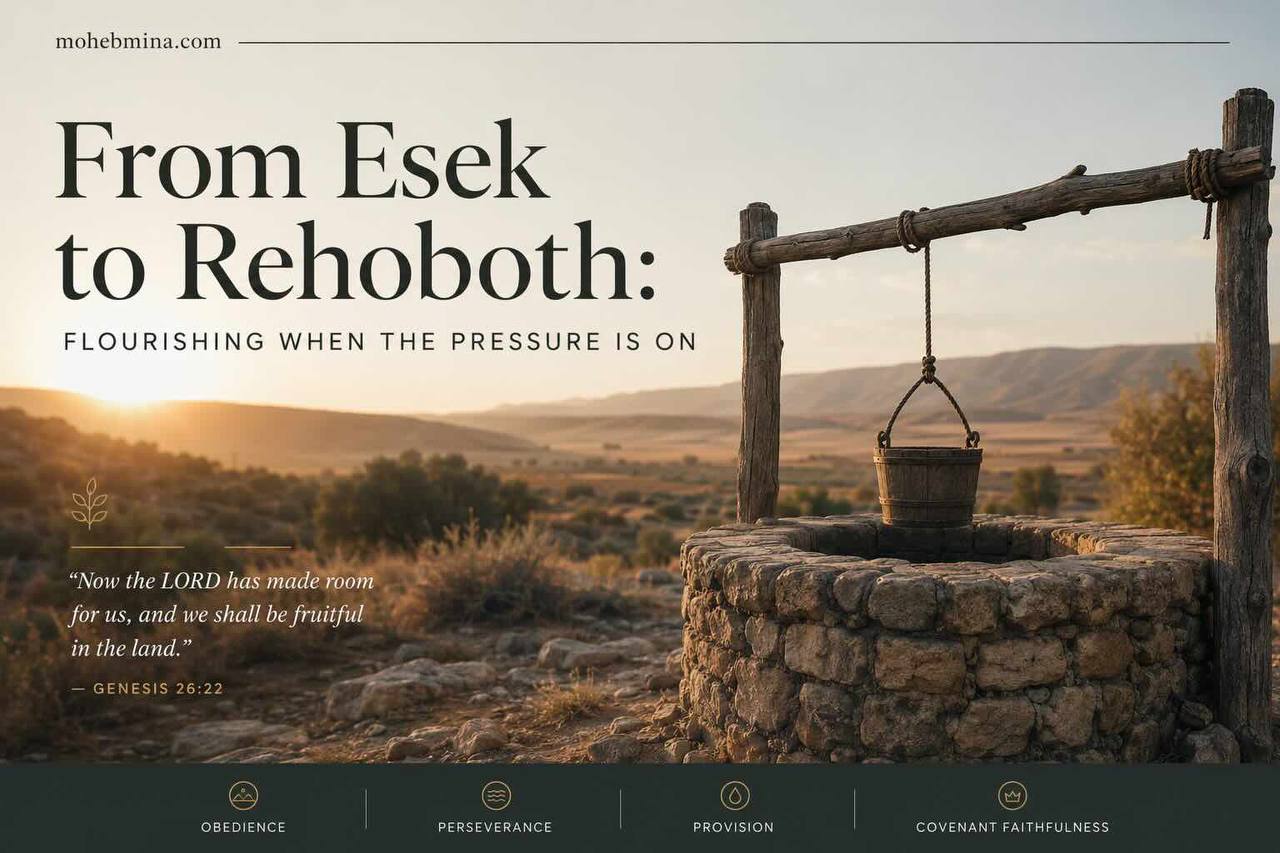
“Now the LORD has made room for us, and we shall be fruitful in the land.”
— Genesis 26:22
This is the well of God came through.
The broad place comes after the disputes, not before. The flourishing comes through the pressure, not around it. There is no shortcut. There is no way to skip from the obedience of Genesis 26:2 to the blessing of Genesis 26:22 without walking through the wells in between.
When you are at Esek, it feels like the end. When you are at Sitnah, it feels like it will never end.
But Rehoboth is ahead — if you keep digging.
Fear: The Real Enemy
But there is something else happening beneath the surface of this chapter that I don’t want us to miss.
Early in the story — before the wells, before the quarrels — we see Isaac’s fear. A famine comes and he tells the men of Gerar that Rebekah is his sister, not his wife. He lied. He was afraid of what they might do to him.
Fear will do that to you. Fear will make you hide what is true. Fear will make you protect yourself in ways that compromise your integrity. Fear will make decisions for you that you will later regret.
And God knew this. Which is why — at the end of the chapter, after all the wells, after all the battles — God appeared to Isaac again and said:
“Fear not, for I am with you.”
— Genesis 26:24
God bookended this entire chapter with the same word: do not be afraid.
Because fear is not just an emotion. Fear is the thing that, left unchecked, will send you to Egypt. Fear is the thing that will make you stop. Fear is the thing that whispers that the battle is too long, the cost is too high, the opposition is too strong, and the sensible thing — the wise thing — is to give up.
And the answer to fear — in Isaac’s life and in yours — is not more courage. It is not trying harder or gritting your teeth and pushing through on your own strength.
It is the presence and the promise of God.
“I am with you.”
That is enough. That has always been enough.
Beersheba: Back to the Foundation
After Rehoboth, Isaac moved — from the valley where he had dug well after well, through the places of contention and hostility, and up to Beersheba. Notice the physical movement. Every step was a step away from the place of conflict and back toward the place of covenant. The geography itself is a picture of spiritual perseverance — you move through the valley, not around it, and the movement itself brings you home.
Because Beersheba was not just any place. It was Abraham’s place. The place of covenant. The place where the foundations were first laid. The place where it all began.
And there, God appeared to him again.
When you have been through the battle — when you have dug through Esek and Sitnah and finally reached Rehoboth — God’s invitation is not to move on quickly to the next thing. It is to come back to the foundations. To come back to the covenant. To come back to what was true before the pressure started and what will remain true long after it ends.
And here is the heart of it all:
God kept His covenant with Isaac not because of Isaac’s performance. Not because he had been strong enough or brave enough or faithful enough. Not because he had never lied or never feared or never doubted.
He kept it for the sake of Abraham.
And God keeps His covenant with you today — not because of your strength, not because of your track record, not because you have never doubted or feared or thought about stopping —
He keeps it for the sake of Jesus Christ.
The ground of your resilience is not you. It is Christ’s finished work. It is the covenant sealed in His blood. It is the promise that cannot be broken because it does not rest on your shoulders — it rests on His.
This is the Gospel response to pressure. Not gritting your teeth and trying harder. But going back to the wells — back to who God is, back to what He has promised, back to what Christ has already done — and drawing your strength from there.
Shebaa: The Covenant That Endures
And the story doesn’t end at Beersheba.
Isaac’s servants dug yet another well — and they found water. Isaac called it Shibah (שִׁבְעָה), and from that the city came to be known as Beersheba — the same name his father Abraham had given it when he made a covenant there (Genesis 21:31). The name echoes both God’s covenant oath and the biblical symbolism of seven, a number often associated throughout Scripture with completeness and fullness. It is as if the ground itself was declaring: God keeps His word.
I don’t want us to rush past this.
God’s faithfulness did not appear for a single moment and then disappear.
Throughout Isaac’s journey, the Lord continued to sustain him. Every new well became another reminder that God’s covenant had not failed. His faithfulness was not exhausted by one act of provision; it continued because it was rooted in His unchanging promise.
This is what I want you to hold onto when you are in the middle of your own Esek — that the God who met Isaac at Rehoboth remained with him at Beersheba. His faithfulness is not confined to one moment of relief; it is woven through the whole journey because it flows from His covenant love.
Every act of faithful obedience becomes another opportunity to discover that God’s faithfulness has not run dry.
The Witness You Didn’t Plan
And then something remarkable happened.
Abimelech came to Isaac — the same king who had told him to leave, representing the very world that had pushed him out and filled his wells with dirt.
And he said:
“We see plainly that the Lᴏʀᴅ has been with you.”
— Genesis 26:28
Isaac didn’t plan that. He didn’t strategise it. He didn’t fight for his reputation or argue his case or try to prove that God was on his side.
He just kept digging. He kept faithful. He kept going — not in his own strength, but anchored to a promise that was bigger than his circumstances.
And his enemies saw it.
That is what faithful witness looks like. Not a campaign. Not a performance. Just a life that keeps going when everything says stop — and in the keeping going, makes visible the hand of God to the very people who were trying to push you out.
Keep Digging
I want to close by speaking directly to you — the one who is tired, the one who is wondering if it’s worth it, the one who has been through your own Esek and your own Sitnah and cannot yet see Rehoboth from where you are standing.
The pressure is real. The opposition is real. The cost is real. The inner voices are real. I am not going to tell you they aren’t — because I hear them too.
But I want to tell you this:
You are not the one who decides when it ends. You are not responsible for the outcome. You are not carrying this on your own strength — and you were never meant to.
Your call is not to succeed. Your call is to be faithful. To stay on the track. To go back to what God said before the storm started and stand on it — even when everything around you contradicts it. To keep digging — not because you can see Rehoboth yet, but because the God who promised it is faithful.
Re-dig the wells.
Go back to who God is. Go back to what He has promised. Go back to what Christ has already secured for you at the cross. Draw your strength not from what you see, but from what He has said.
And keep digging.
Esek is not the end. Sitnah is not the end.
Whether God brings your Rehoboth in this life or in the life to come, His promise will not fail. The spacious place He has prepared for His people is certain, even when the road to it is longer than we expected.
And when, in God’s perfect timing, you look back, you will see that it was never your strength that carried you through. It was His faithfulness. Every step of the way.
“Fear not, for I am with you.”
That is enough. Keep going.
And keep digging. 🌿
Also Read:
- Rediscovering the Church: What Is the Church?
- Psalm 3: My Glory, Lifter of My Head
- Psalm 7: In You Do I Take Refuge
Sources
- Genesis 26 — The narrative of Isaac’s wells: Esek (עֵשֶׂק), Sitnah (שִׂטְנָה), and Rehoboth (רְחֹבֹות)
- Hebrew word studies — Esek (contention/dispute), Sitnah (hostility/enmity), Rehoboth (broad places/room)
- Genesis 26:24 — “Fear not, for I am with you” — God’s covenant appearance to Isaac at Beersheba
- Genesis 26:28 — Abimelech’s declaration: “We see plainly that the LORD has been with you”
Enjoyed this article?
Get new reflections delivered to your inbox every week.