Those Who Have No Name — Living for the Greatest Name
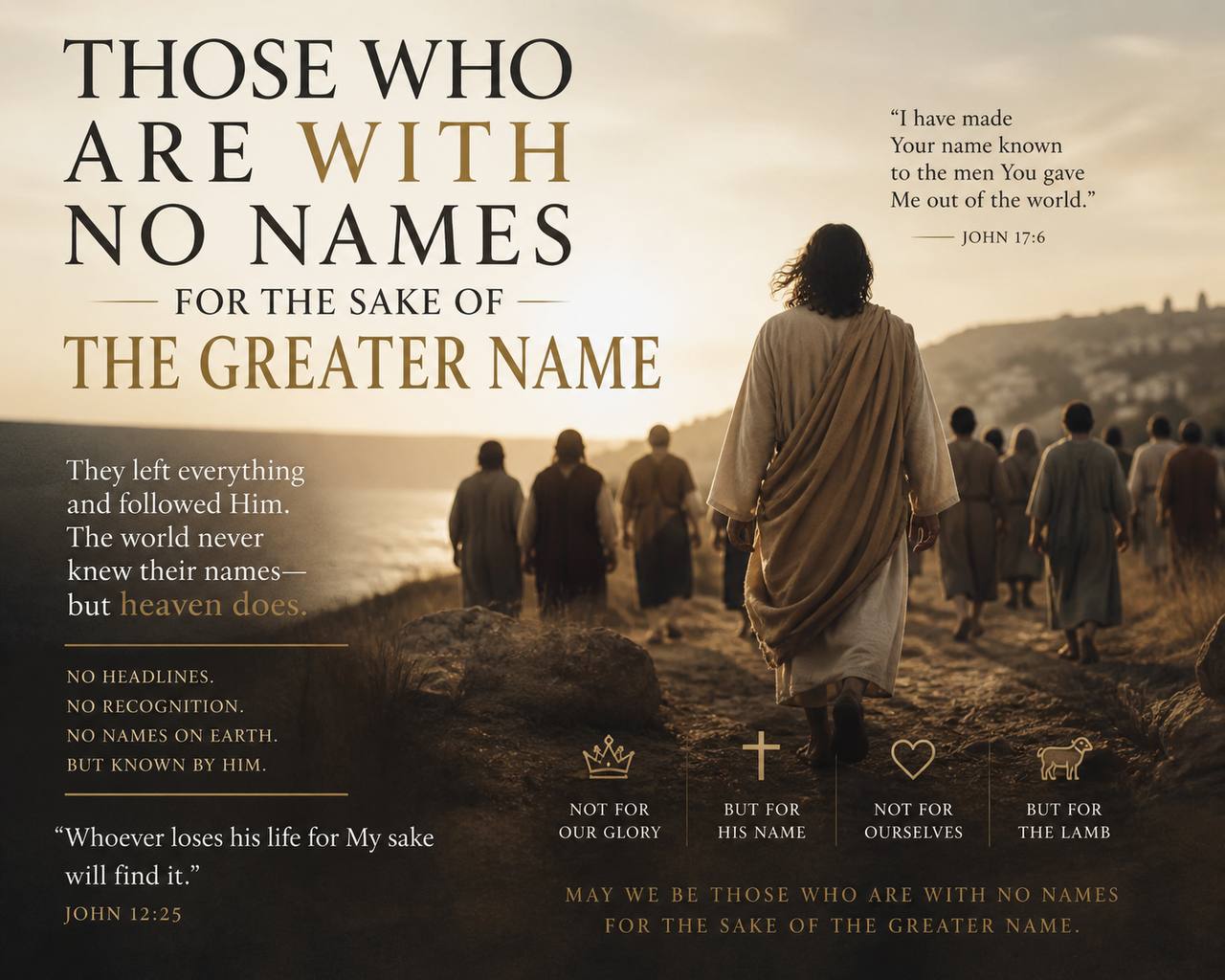
In a world obsessed with recognition, branding, and legacy, one of the most counter-cultural acts of faith is to remain anonymous.
The Gospel of John presents the theme of “Those Who Have No Name” “الذين هم بلا اسم” John the beloved disciple challenges us with a profound spiritual paradox: God calls us to be nameless for the sake of the greatest Name.
This is not about low self-esteem or hiddenness for the sake of hiding. It is about recalibrating our hearts away from self-promotion and toward the glory of the One whose name stands above every other.
Why Is a Name So Important?
From the very beginning, names have carried deep significance. A name expresses identity, belonging, and value.
“So the Lord God formed out of the ground every beast of the field and every bird of the heavens and brought them to the man to see what he would call them.” — Genesis 2:19 (ESV)
Giving names was an act of authority, relationship, and understanding. A name grants dignity even before achievement. It speaks of belonging and worth. In Scripture, God Himself says:
“Fear not, for I have redeemed you; I have called you by name, you are mine.” — Isaiah 43:1 (ESV)
And Proverbs reminds us: “A good name is to be chosen rather than great riches” (Proverbs 22:1, ESV).
Yes, a name matters. It carries relationship, value, reputation, and honor.
The Human Problem: From Gift to Idol
But here is the crisis. The problem is that man is not satisfied with simply having a name. He wants to make a name for himself.
This echoes the ancient rebellion at Babel: “Come, let us build ourselves a city and a tower with its top in the heavens, and let us make a name for ourselves” (Genesis 11:4, ESV).
What was once a gift from God becomes a goal, an obsession, and eventually an idol. The desire for recognition turns inward. We begin to crave human glory rather than divine approval.
David knew this temptation intimately — and he also knew the cure. When his own son stole his throne, when the people threw stones and curses at him, when his head was covered in public shame — David did not try to rebuild his name. Instead he wrote: “But you, O LORD, are a shield about me, my glory, and the lifter of my head” (Psalm 3:3). He found his identity not in what people called him, but in who God said he was. As I reflect on this in Psalm 3 — My Glory and the Lifter of My Head, David shows us that true honour is not what the world gives — it is what God restores.
The World’s Search for Influencers
We live in an age that has redefined success. The world is not just looking for leaders — it is searching for influencers. People with platforms. People with followers. People whose names carry weight.
And the promise is seductive: Your name can matter. Your voice can be heard. You can leave a mark.
There is nothing inherently evil about influence. But the question is not do you have influence? — the question is what are you doing with it, and whose name are you building?
The tragedy of our time is that millions chase significance through visibility. They post, they perform, they compare, they burn out. And even when they gain followers, they find that applause fades and algorithms change. The hunger for significance is never satisfied by the world’s methods.
The gospel offers an alternative path. It does not promise you will be known. It promises you will be loved — by a God who knows your name even when no one else does. And from that deep security, you are free to serve without needing to be called an “influencer.” You can influence one person, or ten, or a thousand — not for your brand, but for His kingdom.
That is not less significant. In the eyes of eternity, it is everything.
John the Baptist Flips the Scale
John the Baptist is one of the models represented by the author of the gospel. He was not the light, but came to bear witness to the light (John 1:8). When his disciples worried that Jesus was drawing larger crowds, John replied: “He must increase, but I must decrease” (John 3:30, ESV).
As the presentation puts it: “God does not call us to have a name, but to live for the One who has the greatest Name.”
Jesus Himself challenged this craving for human praise: “How can you believe, when you receive glory from one another and do not seek the glory that comes from the only God?” (John 5:44, ESV).
Why Anonymous Characters in John’s Gospel?
Interestingly, the Gospel of John features several powerful witnesses whose names are never mentioned:
- The man born blind (John 9): He testifies boldly, yet remains unnamed.
- The boy with the loaves and fish (John 6): He gives his lunch, and we never know his name.
- The invalid at Bethesda (John 5): He is healed, but his identity is hidden.
- The Samaritan woman (John 4): She brings an entire town to Jesus, yet her name is never recorded.
- The woman who anointed Jesus (John 12): Mark’s gospel says her story would be told everywhere, but John does not name her.
Why does John leave them nameless? “God uses unnamed individuals to teach the name of Jesus.”
Their lack of a recorded name is not an oversight. It is their power. They are not pointing to themselves. They are pointing to Him.
The Blind Man Who Saw Clearly
About the man born blind, Andreas J. Köstenberger says: “The blind man sees more clearly than any of the religious leaders… and remains unknown, yet his testimony stands.”
“Whether he is a sinner I do not know. One thing I do know, that though I was blind, now I see.” — John 9:25 (ESV)
No name. No credentials. Just a transformed life pointing to Jesus.
The Beloved Disciple’s Hidden Identity
Even the disciple “whom Jesus loved” remains unnamed. D. A. Carson observes: “The omission of his name is not false humility; it is theological necessity.”
Why? Because the goal is not to build a personality cult. The goal is to magnify Christ.
The Subtle Trap of False Humility
But let us be honest: false humility is real, and it is seductive.
Some Christians hide their gifts behind spiritual language: “Oh, I just want to be unseen.” But underneath, there is fear — fear of failure, fear of responsibility, or worse, a pride that refuses to be known unless it can be known perfectly.
True humility is not denying who you are. True humility is knowing who you are — and who you are not. Paul knew his name. He used it. He wrote letters with authority. He said, “I am the least of the apostles” (1 Corinthians 15:9), but he did not pretend to be anonymous.
The difference is this:
- False humility says: “I have nothing to offer, so I will hide.”
- Gospel humility says: “I have gifts from God, and I will use them for His glory — and I do not need my name remembered to be satisfied.”
Your identity is not found in being unknown. Your identity is found in Christ. And from that secure identity, you can be known or unknown, famous or forgotten, praised or criticized — and it does not move your foundation.
Not a Call to Laziness — But to Sacrificial Living
There is a danger here that must be named. When we hear “God calls us to be nameless,” some might hear: “Then I don’t need to work hard. I don’t need to take initiative. I’ll just disappear and do nothing.”
But that is a misunderstanding.
Being nameless for Christ’s sake is not passive — it is sacrificially active. The boy with the loaves still gave his lunch. The Samaritan woman still walked back to her town. The man born blind still opened his mouth to testify. None of them sat down. They served, they spoke, they gave — they simply did not demand credit for it.
“The call is not to laziness. It is to labor without applause.”
It is to build, teach, give, lead, and serve — and then to be content when no one knows your name. That is far harder than performing for praise. Anybody can work hard for a standing ovation. It takes the Spirit of God to work hard for an unseen King.
The Problem of Fame
The world says: Make a name for yourself.
The gospel says: Disappear, so that the name of Jesus may appear.
John Piper writes: “We want to be famous… but the gospel calls us to be forgotten for Christ’s sake.”
Dietrich Bonhoeffer adds: “Anyone who loves their own fame cannot serve the church, because the name of Christ is what matters.”
Fame, applause, and recognition can become spiritual traps. They distract us from true purpose: serving others and glorifying God.
Application: Can I Disappear?
This message ends with piercing personal questions. Let me leave them with you, along with one more.
-
Can I disappear from the spotlight so that the name of Christ shines in my life and in the lives of others?
-
Can I be faithful without applause? Can I serve, give, and obey without waiting for thanks or recognition?
-
Am I ready to serve without fame? Without a title, a stage, or a following?
-
Am I hiding or am I serving? Is my “namelessness” an excuse for laziness, or is it truly for God’s glory?
You May Be Nameless Before Men, But Known by God
Here is the beautiful conclusion: You may be nameless before people, but you are known by God.
Jesus said to His disciples:
“No longer do I call you servants, for the servant does not know what his master is doing; but I have called you friends, for all that I have heard from my Father I have made known to you.” — John 15:15 (ESV)
And the purpose of John’s gospel is this:
“These are written so that you may believe that Jesus is the Christ, the Son of God, and that by believing you may have life in his name.” — John 20:31 (ESV)
Not life in your name. Life in His name.
Final Question
John’s gospel places this challenge before us: What name are you living for?
But let us add one more question: Am I hiding, or am I serving?
If you have no name in the halls of power, no title in the pages of history, no recognition from the crowd — take heart. You are not forgotten. You are called.
And if you do have a name — if you lead, if you teach, if people know who you are — then do not shrink back in false humility. Use your name. But use it as a steward, not an owner. Let your influence point away from yourself. Let your name be small so that His name becomes great.
“Live not to be known. Live to make Him known.”
And whether you are named or nameless, remembered or forgotten — rest in this: Your name is written in the Lamb’s book.
Also Read:
Enjoyed this article?
Get new reflections delivered to your inbox every week.